

If you’re the one who remembers the dentist appointments, keeps the pantry stocked, manages the calendar, and somehow also brings in an income — this one’s for you. Because here’s a truth that doesn’t get said enough: the person holding a family together often has the least protection around her. New data shows the women’s life insurance gap is now the widest it’s been in the study’s entire history. And if you’ve been putting your own coverage at the bottom of the list, you’re in very good company — which is exactly the problem we want to help you fix.
Not sure where to start? Our guide on how much life insurance you need breaks it down, and if you’re newly married, here’s what to set up as newlyweds. For a neutral overview of coverage basics, see Investopedia’s life insurance guide.
Table of Contents
The women’s life insurance gap just hit a record high
According to LIMRA’s Insurance Barometer Study, women are now 11 percentage points less likely to own life insurance than men — the widest gap in the study’s 14-year history. Break it down and it’s roughly 49% of women covered versus 55% of men. That gap isn’t shrinking as women earn more and lead more households. It’s growing.
Even more telling: about 44% of women — that’s around 54 million of them — say they know they have a coverage gap and need more protection. They’re not unaware. Life just keeps moving the appointment. And in many households where a woman is covered, her policy is noticeably smaller than her partner’s, even when she’s contributing just as much financially and doing the lion’s share of the unpaid work at home.
You can read the numbers straight from the source in LIMRA’s report on the women’s market. But the headline is simple: the people doing the most to hold families together are the most underinsured.
[IMAGE: mom working on a laptop at the kitchen table — alt text: “the women’s life insurance gap — a mom managing the household budget at home”]
Why the women’s life insurance gap keeps growing
This gap didn’t happen because women don’t care. It happened because of a stack of small, understandable reasons that add up over time. When we talk with families, the same themes come up again and again.
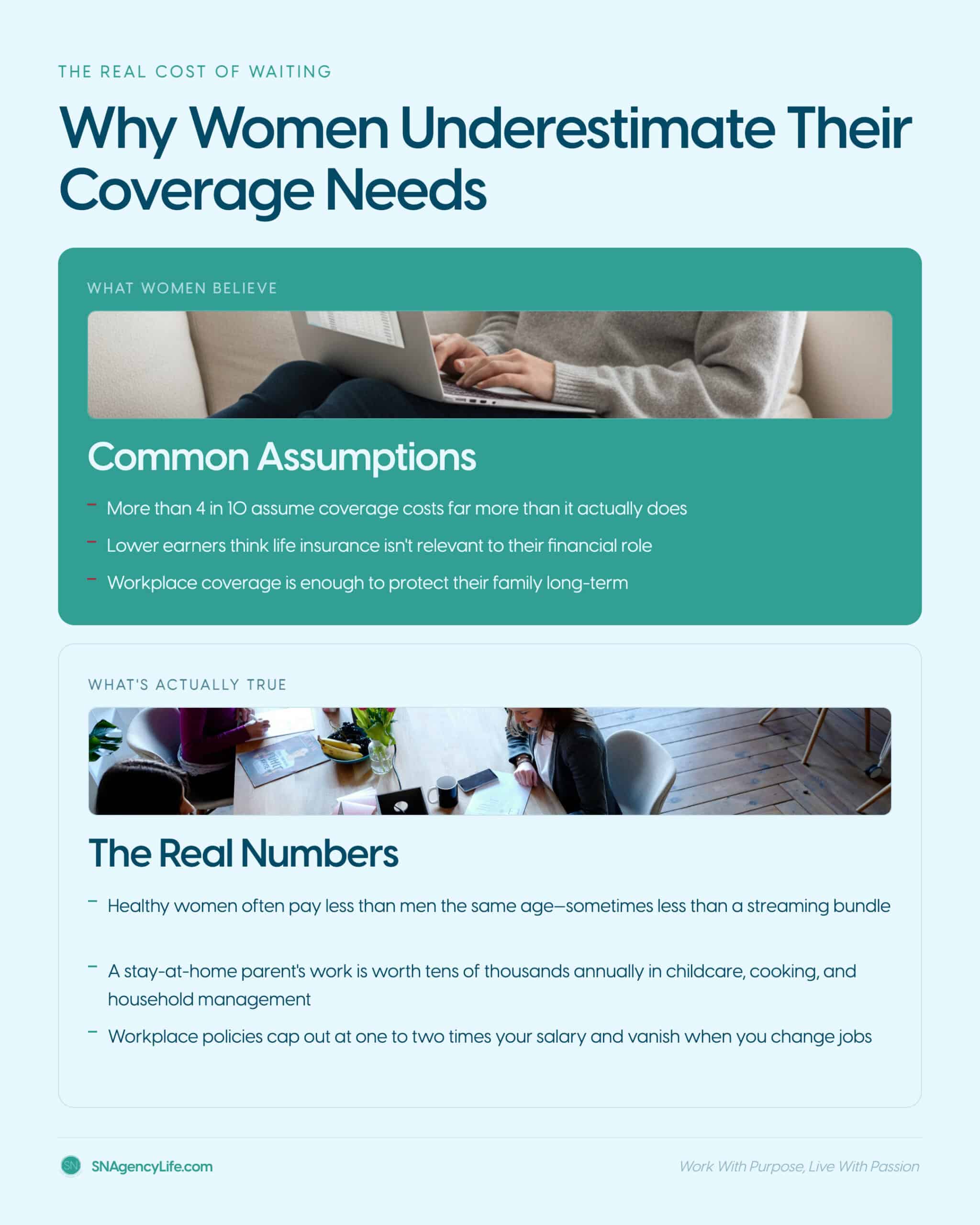
- “It’s too expensive.” More than 4 in 10 women assume coverage costs more than it does. In reality, a healthy woman often pays less than a man the same age — and term policies can cost less than a streaming bundle.
- “I don’t earn the most, so it’s not really about me.” This one hurts, because it misses the point. If a stay-at-home or lower-earning parent were gone tomorrow, someone has to pay for childcare, cooking, driving, and household management — work worth tens of thousands a year.
- “I have a little coverage through work.” Workplace policies are a nice start, but they’re usually one to two times your salary and they don’t follow you when you change jobs.
- “I’ll get to it later.” Coverage is cheapest and easiest to qualify for when you’re young and healthy. “Later” almost always costs more.
Add in the fact that women still carry the majority of unpaid household labor and often manage the family’s day-to-day finances, and it makes sense that their own protection is the thing that quietly slips. The fix isn’t guilt. It’s a plan.
What “enough” coverage actually looks like for a woman running a household
Here’s the reframe we love: life insurance isn’t about replacing a paycheck. It’s about replacing everything you do. So when you’re figuring out how much you need, count the whole picture, not just your salary.
Add up what your family would actually have to cover
- Income you contribute (even part-time or seasonal)
- The cost to replace the unpaid work you do — childcare, meals, transportation, household management
- Any debt in your name, including a shared mortgage
- Future goals you’d want protected — your kids’ education, keeping the family in the same home
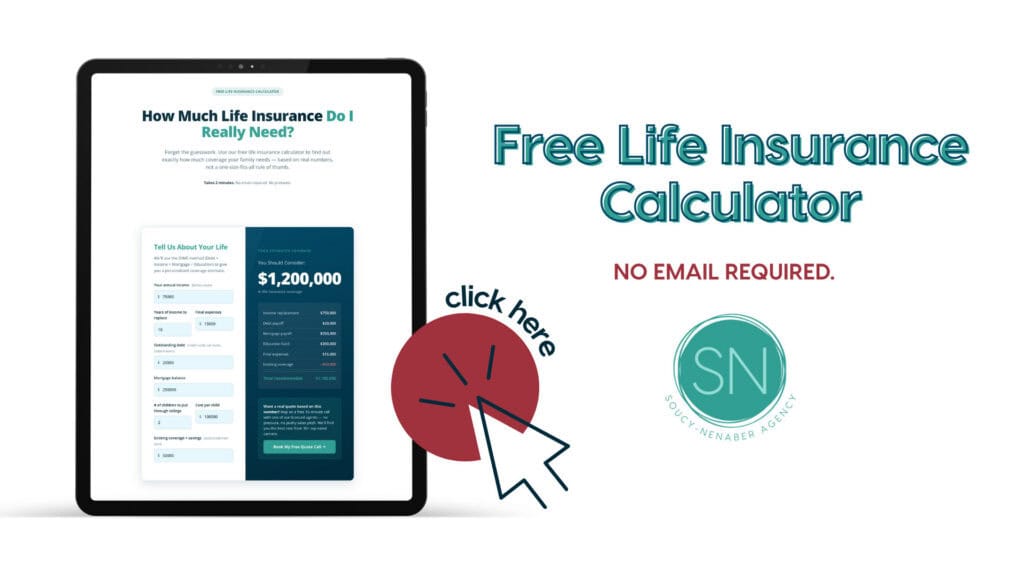
A common rule of thumb is 10 to 12 times your annual income — but if you’re the household’s default problem-solver, don’t stop at the salary line. Factor in the value of everything that would suddenly need to be hired out or covered. A quick way to get a real number is to run your own scenario in our free life insurance calculator — it takes a couple of minutes and gives you a ballpark you can actually work with.
The good news about the price tag
Because the biggest barrier is a misunderstanding about cost, let’s be clear: term life insurance for women is often surprisingly affordable, especially when you lock it in while you’re young and healthy. You don’t have to choose between protecting your family and staying inside your budget. You just have to see real numbers instead of guessing at scary ones.
[IMAGE: two women talking over coffee, laptop open — alt text: “a woman getting simple, no-pressure guidance on life insurance”]
Closing the gap without the pressure
At SN Agency, we come at this differently. Jamie’s background is nursing, Cory’s is education — neither of us came from the high-pressure sales world, and we built this agency specifically so families could get honest guidance without the intimidation. As non-captive brokers contracted with 30+ top-rated carriers across 47 states, we’re not here to push one product. We’re here to help you find the coverage that actually fits your life.
And if reading this stirred up something bigger — if you’re a woman who’s tired of being underserved and underrepresented and you want meaningful work helping people like you — this industry needs more women in it, not just insured by it. You can explore that side of the door through our free career fit quiz anytime.
Frequently Asked Questions
Q: What’s causing the women’s life insurance gap?
A: It’s a mix of factors — women more often assume coverage is too expensive, undervalue their own economic and household contribution, and lean on limited workplace policies. Add in busier caregiving loads, and their own coverage tends to slip down the list. The gap is now the widest in LIMRA’s 14-year study history.
Q: Do stay-at-home moms need life insurance?
A: Absolutely. If a stay-at-home parent were gone, the surviving family would have to pay for childcare, meals, transportation, and household management — costs that add up to tens of thousands of dollars a year. Life insurance protects against that very real financial hit.
Q: How much does life insurance for women cost?
A: Often less than people expect. Healthy women frequently pay lower premiums than men the same age, and a term policy can cost less than a monthly streaming bundle. The only way to know your real number is to get a personalized quote — guessing almost always overestimates it.
Q: How much life insurance do I actually need?
A: A common starting point is 10 to 12 times your annual income, but women running a household should also factor in the cost of replacing unpaid labor, any shared debt, and future goals like their kids’ education. Running the numbers through a calculator or a quick call gives you a far more accurate figure.
Your family is worth the ten-minute conversation
You spend your days making sure everyone else is taken care of. Making sure you’re covered too isn’t selfish — it’s the most protective thing you can do for the people who depend on you. The gap is real, but on your family’s balance sheet, closing it is simple: get an honest number, see how affordable it really is, and put a plan in place.
Let’s make sure you’re covered too. Book a free, no-pressure quote call with SN Agency, or run your own numbers in our calculator first — whatever feels easier. Either way, you’ll finally be able to check this off the list and get back to everything else you do so well.